

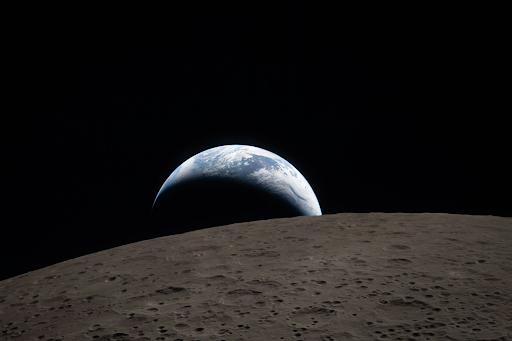
After the National Aeronautics and Space Administration (NASA) successfully conducted the Artemis II mission, widespread interest in space exploration brought attention to all of the missions as a whole. The goal of these highly-anticipated operations are to prepare humans for a sustainable base on the moon, make further discoveries, and lay the groundwork for colonizing Mars in future expeditions.
Currently, the mission is divided into five separate missions, Artemis I – Artemis V; NASA says each one has their own individual goal, but they all fall under the umbrella of exploring and developing lunar technology in order to eventually create a moon base before looking towards Mars.
Artemis I took off on Nov. 16, 2022. According to The European Space Agency (ESA), in order to ensure Artemis II went smoothly, NASA tested their spacecraft, Orion, on an unmanned flight around the moon. The mission lasted a total of 25 days, during which Orion orbited the lunar body two full times before landing safely back home. Orion is familiarly known as Integrity, named by the crew.
According to NASA, the second mission—originally scheduled to launch in 2024—faced numerous technical challenges before finally taking off from the Kennedy Space Center on April 1, 2026. After Orion launched into high Earth orbit, along with Reid Wiseman, Victor Glover, Christina Koch, and Jeremy Hansen. They stayed in orbit for 25 hours before setting off for the moon. Interestingly, most of the heavy lifting was done by the gravity of both Earth and the Moon. After being properly aligned, they exited the pull of Earth and let the Moon’s gravity take over. While in the Moon’s orbit, two new craters were discovered. The first was named Integrity, after the Orion spacecraft. The second was named Caroll, named after Wiseman’s late wife, who passed away in 2020.
BBC says that NASA predicted they would lose contact with Orion as the spacecraft passed behind the Moon. True to their word, the Artemis crew went silent for around 40 minutes, with all communications paused as the Moon blocked all laser and radio signals transmitted between Earth and the spacecraft. Back on Earth, mission control did everything they could to make sure they would be able to reconnect with those on the spacecraft. In Cornwall, England, a massive antenna was set up in an attempt to track Orion and send information back to NASA. There are already plans to fix this vital communication error, with a new program called Moonlight, led by the ESA. Moonlight’s mission is to set up a ring of satellites around the Moon, in hopes that it will help telecommunication and prevent the loss of contact in future missions.
Artemis II was especially significant because it was the first crewed spacecraft to orbit the Moon in over 53 years. It set many records, most notably being that Artemis II took the crew farther than humans ever traveled before, measuring in at 252,756 miles from Earth. The 10-day mission concluded with a difficult re-entry into Earth’s atmosphere before safely splashing down off the coast of San Diego on April 10, 2026. They were retrieved by divers from the U.S. Navy, making it the first crewed mission to be recovered since the early 1970s.
From Artemis III and onward, everything is subject to change. According to PBS, as of now, the mission plans to test low Earth orbit docking with the Lunar Gateway (a small space station orbiting the Moon) in 2027. Orion will test attaching to the SpaceX Starship HSL, which will play a vital role in future missions, transporting astronauts from the docking station to the surface of the Moon.
According to NASA, the mission includes multiple complex steps, but the agency remains optimistic that Artemis IV is set for early 2028. First, Orion will take the crew to the Moon’s orbit, where it will dock with the Lunar Gateway. Some of the crew will then take the lunar lander to the south pole of the Moon, where they will likely study materials, conduct experiments, and test new technologies. The crew will then take the lander up to the other astronauts and re-dock, before traveling back to Earth.
Planned for late 2028, Artemis V and further missions aim to create long-term infrastructure and establish technology that will be further explored for missions to Mars.
All of the Artemis missions are very exciting and promising for the future of space exploration and science as a whole. Even though it will come with many challenges, NASA hopes to prepare for the next hurdle: Mars.


