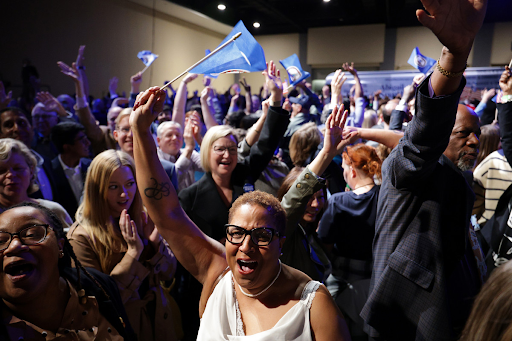
The Democratic Party has been repeatedly battered over the last year with electoral victories from President Trump’s administration and America’s growing shift towards conservatism. But the announcement of midterm election results after voting on Nov. 4 saw a surprising wave of blue across the United States, giving the party a much-need reinvigoration. The results saw four major victories in New York, Virginia, New Jersey, and California, along with more progressive results in other local and state elections in the nation.
New York City saw a historic voter turnout for its mayoral elections, with 39% of the city’s registered voters showing up, a number that hasn’t been seen since 2001, and a total of over two million votes being cast, the highest rate since 1969 reports The City. Zohran Mamdani was elected as New York City’s mayor, beating out former governor Andrew Cuomo and Curtis Silwa. The 34-year old candidate ran as a democratic socialist, a remarkably progressive stance compared to many current members of the Democratic Party. Mamdani’s win made him the city’s first ever Muslim and South Asian mayor as well as the youngest in a century. Moreover, this victory displays the power of young voters, who played a key role in the mayor-elect’s win, and showcases the growing progressiveness of their perspectives. During his campaign, Mamdani faced harsh criticism from a wide range of politicians targeting anything from his race to religion to more progressive political stance, most notably with President Trump calling him a “communist” in a TruthSocial post along with other negative claims of Mamdani’s future governance.
Close by, New Jersey and Virginia’s gubernatorial races were won by Mikie Sherrill and Abigail Spanberger with double-digit victories, respectively. Spanberger, a former representative and Central Intelligence Agency agent, made history, becoming the first woman in Virginia’s history to be elected governor. The BBC reported Sherrill, who is currently a Congresswoman and formerly a Navy pilot, focused her campaign on opposing Trump and beat out her Republican competitor who was backed by Trump. Although New Jersey has historically voted blue, the tight race indicated that the “governorship could flip to a Republican” stated NPR.
On the opposite side of the country in California, Proposition 50 passed. California’s Governor Gavin Newsom proposed a plan to temporarily replace the current congressional map with a redrawn map by the California State Assembly, after the census takes place. Redistricting typically occurs at the beginning of a decade when the decennial census occurs, though . With a 64.4% support rate at the booths, the proposition adds five seats for Democrats in Congress according to California’s Secretary of State.
The proposition was created in response to Trump’s calls for redistricting in order to maintain a Republican majority in Congress, leading Texas, Ohio, North Carolina, and Missouri to pass gerrymandering measures granting the Grand Old Party (GOP) a potential total of nine new seats in Congress. GOP members in other states are rallying behind Trump’s demands and working to redistrict areas of their states in favor of adding more Republican seats. Although California’s Prop. 50 doesn’t affect districts and partisan seats outside of the state, Democrats hope to follow in their lead to gerrymander and balance out the GOP’s efforts. According to Axiois, Republicans believe they will be able to flip seats in Florida, Indiana, Louisiana and Missouri, while Democrats aim to turn seats in Illinois, Maryland, New York and Virginia blue. For more information and visuals on states’ efforts to redistrict, refer to NPR’s recent tracker.
MSNBC reported the Department of Justice (DOJ) filed legal action against California on Nov. 13, joining a pre-existing case started by California Republicans. The DOJ alleged Newsom and other legislators engaged in racial gerrymandering, a practice prohibited under the Constitution, accusing them of creating “a map that manipulates district lines in the name of bolstering the voting power of Hispanic Californians because of their race”. Republicans currently hold a close majority in Congress, with 219 members to the Democratic party’s 214 members in the House of Representatives and appear to be attempting to maintain their narrow hold.
The Democratic party also saw success in smaller districts and more throughout the United States. In Mississippi, two Democrats flipped long-held Republican Senate seats, a shocking result from the state’s red supermajority states Politico. Legislators were also ordered by a federal court to redraw 14 districts from 2022 which were found to have discriminated against the regions’ Black voters. Georgia’s Public Service Commission saw two seats turn, with Democrats bringing about the state’s first win in a nonfederal statewide office since 2006. Three Democratic Supreme Court judges in Pennsylvania retained their seats. Pennsylvania Democrats saw more victories in flipping a seat on their Superior Court and Commonwealth Court and other county executive positions. In the Virginia House of Delegates and New Jersey’s General Assembly, Democrats gained a majority, reports NPR. Other local races throughout America resulted in the election of more Democratic legislators, such as those in Connecticut, Florida, New York, South Carolina, and more.
Left-leaning stances on policies nationwide were also shown support by voters. AP News reported 64% of Maine voters opposed a measure that would require voters to show photo identification and restrict absentee voting. Similar policies have been proposed by other GOP legislators as party members raise claims of voter fraud and tampering. Other Democrat-backed measures passed in the U.S., with a common trend of affordability in many of the policies.
One of the driving forces behind the “blue wave” of this year’s elections is Latino voters, particularly those who previously backed Trump late last year. Regions with a Latino majority saw large shifts to voting in Sherrill and Spanberger in gubernatorial elections by at least a 2-1 margin. According to CNN, Latino voters’ support of the Republican party since March has “dropped from 26% to 16%, while the Democratic Party’s rating has mostly held steady, going from 37% to 34%”. Disillusionment is growing among Latino voters with Trump’s presidency and issues like the economy and immigration remaining at the forefront of this demographic’s minds. Polling conducted by CNN show disapproval rates have increased among Latino voters concerning Trump’s approaches to immigration and economic conditions leading many to vote for Democratic candidates. The Latino vote has been a crucial audience in every election and in the past few years, Democrats have been working hard to appeal to this rapidly-growing voting bloc with hopes to gain a party advantage. Although 2025’s off-season elections displayed a shift in the Latino vote, the voting coalition’s patterns are unclear for future elections.
Victorious Democratic candidates from midterms shared some similar approaches to policies which also contributed to Democrats’ success. The cost of living has been a top issue for most Americans as utility bills, groceries, and more everyday expenses continually increase with no end in sight. A large cornerstone of Mamdani’s campaign was focused on lowering the cost of rent and deducting funds from the city’s elite. Both Sherrill and Spanberger led successful campaigns with the promise of lowered utility bills and featuring anti-Trump rhetoric.
Right now, Americans seem to be most concerned with rising costs and the extremity of some actions taken by the Trump administration and its conservative counterparts. For Democrats to recover from their recent falls in the eyes of the American public, the party needs to take advantage of top issues of the everyday American. More importantly, Democratic politicians must showcase follow-through on their promises, their lack-thereof has been a common criticism from both parties. With the Democrats’ failure to procure extensions for the Affordable Care for Americans Act and allowing the government to re-open, their ratings are likely to drop further from the 37% favorability rate Gallup reported in September – though Republicans only surpassed the Democrats by a three-point margin. A study conducted by the Pew Research Center in October showed three quarters of Americans say they are frustrated with the Democratic Party, while 64% say they are frustrated with the GOP. The Democratic Party has an invaluable opportunity to regain popularity and power with Trump’s net rating most recently dipping to -16% as reported by The Economist, but cannot allow their history of yielding to GOP politics to interfere.
The blue wave seen in 2025’s midterms does not guarantee Democrats’ come-back in key, future elections, instead it displays a reinvigorating hope for a tired party and its supporters for a massive blue shift in the coming year, similar to 2018 midterms.