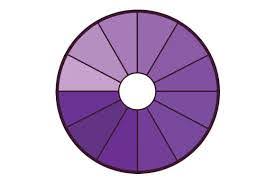
According to Betterhelp, in the United States, one of the most popular colors is purple. Throughout history, it’s been associated with royalty, power, luxury, and prosperity. The color was exclusively used by emperors in early ages and was considered a sign of wealth. Recently, purple has lost its place as it’s been proved that the beloved color doesn’t exist in nature.
Human eyes perceive light through wavelengths on the electromagnetic spectrum, says Maplesoft. Colors are essentially charges that our brain translates into color, based on the length of each wave. Red has the longest wavelength, while violet has the shortest. Violet is, surprisingly, not the same as purple, because purple is the combination of red and blue on the spectrum and violet has its own individual wavelength. Looking at a color spectrum, though, red and blue seem to be on opposite sides. Up until recently scientists didn’t understand how the brain combined two wavelengths that seemingly didn’t ever touch.
Popular Mechanics states that the human brain does something special, it bends the color spectrum into a circle. This way, the wavelengths will overlap, and by doing so, our eyes will see a new color: purple. Purple is a non-spectral color, a combination of wavelengths, such as magenta, pink, and purple.
Even though purple doesn’t exist naturally, it still lives on in many hearts.