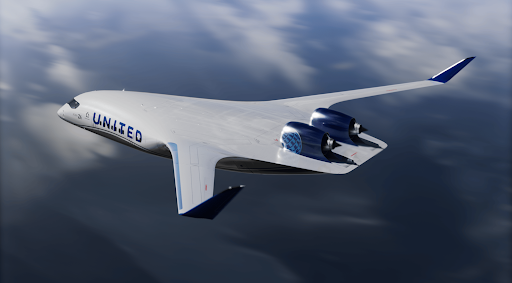
Blended wing aircrafts have been a concept of science fiction for years, but they may enter reality sooner than once thought. The blended wing aircraft is the same as any other commercial aircraft, except one defining feature. On blended wing aircrafts, there is no definite line between the wings and the main body. This design faces significantly less air resistance, which makes it much more fuel efficient.
According to BBC, a standard commercial Blended Wing Body (BWB) can hold up to 230 passengers, while a regular Boeing 737 can only hold up to 200. This means that the blended wing can hold more people while also saving more fuel.
While BWBs might seem new to the world, they actually date back a hundred years ago. In 1924, the first BWB took flight, but crashed shortly after. About 65 years later in 1989, the U.S. military adopted the blended wing design. Promotex says that the BWB was proposed as a stealth bomber, also known as a B-2 stealth bomber, and was first serviced in 1990. Until now, the BWB was pretty much preserved for the military.
Naturally, a lot of science went behind the plane’s design. Vicomplex says that the body of a BWB saves 1,000sq-ft of surface area compared to a traditional aircraft. This is because a lot of time went into minimizing the load and surface area of the plane. A modern airplane’s body takes up about 23,000sq-ft in surface area, while a BWB only takes up 22,000sq-ft. The BWB’s wings take up 4,000sq-ft, while a traditional aircraft takes up 12,000sq-ft. Engines, and controls integration only takes up 1,200sq-ft in a BWB opposed to 9,000sq-ft for a normal aircraft. Overall, the BWB saves 14.3 thousand square feet of surface area, that’s enough surface area to reconstruct almost half of this BWB model.
While saving fuel, and space, the blended wing aircraft will be a great alternative and could potentially replace the modern aircraft.